This page draws from SSA Publication EN-05-10029 (Disability Benefits, 2025 edition), 20 CFR §404.621 (underpayments — time and manner of payment), and 20 CFR §404.316 (the five-month waiting period rule). Calculator logic reflects SSA’s standard back pay computation methodology. Figures verified as of May 2026.
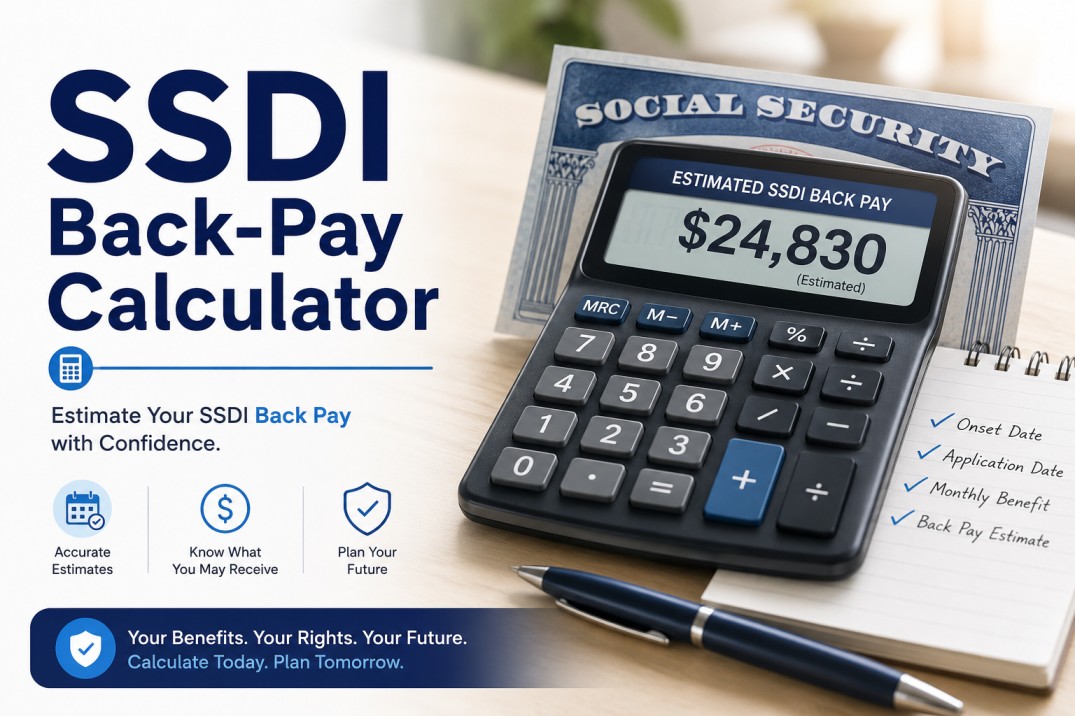
SSDI Back Pay Calculator – Estimate Your Exact Payment in 2026
Most people filing for SSDI know they might be owed money for the months they waited. Few know exactly how much — or why the number is almost always lower than expected.
This calculator gives you a real estimate based on SSA’s actual formula: your monthly benefit amount, your established onset date, your application date, and the mandatory five-month waiting period that SSA deducts before your first eligible payment. Enter your numbers below and get your estimated lump sum in seconds.
SSDI Back Pay Calculator — 2026
Enter your dates below. All fields except attorney fee are required. Results update instantly and follow official SSA rules under 20 CFR §404.315.
When SSA determines your disability began
Found in your SSA decision letter
Date you officially filed for SSDI
Date SSA formally approved your claim
Your SSDI monthly payment (2026 avg: $1,630)
Fee deducted from back pay automatically
Estimated SSDI Back Pay
| Detail | Value |
|---|
Estimate only — not an official SSA determination. Actual back pay depends on your SSA-established onset date, official PIA, and any applicable offsets. See SSA Publication EN-05-10029.
How SSA Calculates Your SSDI Back Pay — The Exact Formula
SSA does not pay benefits for every month you were disabled. The rules that govern back pay are specific, and they reduce your total in ways that catch most applicants off guard. Understanding the formula is the first step to knowing whether your eventual payment matches what you were owed.
Step 1 — Establish your Established Onset Date (EOD)
Your Established Onset Date is the date SSA formally determines your disability began. This is not automatically the date you stopped working or the date your doctor first diagnosed you. SSA adjudicators evaluate medical evidence and assign an EOD under 20 CFR §404.1512. It may be earlier or later than the date you claimed.
Every month between your EOD and your approval date is potentially owed to you — subject to the rules below.
Step 2 — Apply the Five-Month Waiting Period
Under 20 CFR §404.316(b), SSA does not pay benefits for the first five full calendar months of your disability — regardless of when you applied, how severe your condition is, or how long the adjudication took. The waiting period starts from your EOD.
If your EOD is June 15, 2023, your waiting period covers July, August, September, October, and November 2023. Your first eligible payment month is December 2023.
Step 3 — Determine the Earlier of EOD+5 Months or Application Date
Back pay begins from whichever is later: the end of your five-month waiting period, or your application date. Applying late — after your condition had already been disabling for a year or more — caps your retroactive pay.
There is a 12-month retroactive limit on how far back SSA can pay for SSDI, under 20 CFR §404.621(a). Even if your disability began three years before you applied, SSA will only pay back to 12 months before your application date (after the five-month waiting period). This cap is one of the single most financially consequential rules in the SSDI system — and one of the most underexplained.
Step 4 — Multiply Eligible Months by Your Monthly Benefit Amount (MBA)
Your monthly benefit amount is calculated by SSA based on your lifetime earnings record — specifically your Average Indexed Monthly Earnings (AIME) converted to a Primary Insurance Amount (PIA) through SSA’s benefit formula. You cannot calculate this yourself with precision without your full earnings record, but SSA’s online portal (my Social Security) shows your estimated benefit amount.
The back pay formula:
Back Pay = (Approval Month − First Eligible Payment Month) × Monthly Benefit Amount
A Real Example: What the Numbers Actually Look Like
Marcus Rivera, 44, software engineer
- Disability onset (EOD established by SSA): March 1, 2023
- SSDI application date: August 15, 2023
- SSA approval date: February 20, 2025
- Monthly benefit amount (PIA): $2,240
Step-by-step:
| Step | Calculation | Result |
|---|---|---|
| Five-month waiting period | March–July 2023 (5 full months) | Waiting period ends |
| First eligible payment month | August 2023 | |
| Application date | August 2023 | Same month — no application cap applies |
| Approval month | February 2025 | |
| Eligible back pay months | August 2023 → January 2025 | 18 months |
| Back pay calculation | 18 × $2,240 | $40,320 |
Marcus received a lump sum of $40,320 deposited to his bank account approximately 60 days after his approval letter. Under SSA policy, lump sum back pay for SSDI is typically paid within 60–90 days of the official approval notice.
What would have changed if Marcus had applied 14 months later:
Had Marcus applied in October 2024 instead of August 2023, the 12-month retroactivity cap under 20 CFR §404.621(a) would have limited his back pay to October 2023 (12 months prior to his application) at the earliest — reducing his back pay from $40,320 to approximately $6,720 (3 months × $2,240).
The cost of a delayed application: $33,600.
The Five-Month Waiting Period — What It Means in Practice
SSA’s five-month waiting period is one of the least-discussed rules in the SSDI system, but it affects every single applicant.
It exists because Congress designed SSDI to cover long-term disability, not short-term illness. The waiting period — established under 42 U.S.C. §423(c)(2) — filters out conditions that resolve within months. In practice, it means:
- You will never receive SSDI payments for the first five months of your disability period, no matter what
- If your total wait from EOD to approval is seven months, your back pay covers only two months, not seven
- If your total wait is five months or less, you receive zero back pay
For most SSDI applicants — whose average adjudication takes 7 to 24 months — the waiting period reduces back pay by five months’ worth of benefits. At the average 2026 SSDI monthly benefit of approximately $1,580 (SSA Annual Statistical Report, 2025), five months equals $7,900 that no applicant ever receives, regardless of how long their disability had been established.
SSI does not have a five-month waiting period — benefits are paid from the month of application if eligibility is established. This is one of the practical differences between the two programs our SSI vs SSDI comparison covers in detail.
The 12-Month Retroactivity Cap — The Rule That Costs Late Applicants the Most
Under 20 CFR §404.621(a), SSDI retroactive benefits cannot be paid for any month more than 12 months before the month of application.
This rule exists independently of the five-month waiting period. Both apply.
How the two rules interact:
If you apply for SSDI and your EOD is established as 30 months before your application date, SSA applies both:
- The 12-month retroactivity cap (cutting off anything beyond 12 months before your application)
- The five-month waiting period (applied from your EOD — meaning SSA may eliminate up to 5 more months from the capped period)
Example:
- EOD: January 2021
- Application date: July 2024
- Approval date: March 2025
Without the retroactivity cap, back pay would start from June 2021 (after five-month wait). With the cap, back pay starts from July 2023 (12 months before application) — but the five-month waiting period is already satisfied by January 2021 + 5 months = June 2021, which precedes the cap date. So back pay starts July 2023.
Eligible months: July 2023 → February 2025 = 20 months
At $1,580/month average: $31,600
Without the cap (hypothetically): June 2021 → February 2025 = 45 months = $71,100
The difference: $39,500 — gone because of a late application.
[TOOL OPPORTUNITY: A “cost of delay” calculator showing how much back pay is forfeited for each month an application is delayed would be a high-engagement tool for this page. No similar tool exists on major SSDI information sites.]
SSDI Back Pay vs. Retroactive Pay — They Are Not the Same Thing
Many sources use these terms interchangeably. They describe different periods of payment.
Retroactive pay covers the period between your Established Onset Date (after the five-month wait) and your application date. This is money owed for months you were disabled before you even filed.
Back pay covers the period between your application date and your approval date. This is money that accumulated while SSA was processing your claim.
| Payment Type | Period Covered | Cap Applies? |
|---|---|---|
| Retroactive Pay | EOD (+5 months) → Application Date | 12-month cap applies |
| Back Pay | Application Date → Approval Date | No cap — full period owed |
| Total SSDI Arrears | Combined retroactive + back pay | Retroactive portion capped |
In practice, SSA pays both together as a single lump sum. The distinction matters primarily for calculating how much you’re owed and understanding why the number may be less than you expected.
Our detailed article on SSDI back pay calculation methodology covers the full SSA process including how payment is delivered and the timeline after approval.
How Back Pay Is Paid — Timing and Method
After SSA approves your claim, the back pay process typically follows this timeline:
| Milestone | Typical Timeframe |
|---|---|
| Approval notice mailed | Immediately after determination |
| First ongoing monthly benefit | Following month after approval |
| Back pay lump sum deposited | 60–90 days after approval notice |
| Attorney fee withheld (if applicable) | Deducted before lump sum deposited |
SSA pays back pay via direct deposit to the bank account on file, or by paper check if no direct deposit is established. SSA Publication EN-05-10029 confirms that back pay is generally issued as a single lump sum, not in installments — with one exception.
The SSI installment rule does not apply to SSDI. SSI recipients who receive large back pay amounts (over 3 times the monthly SSI benefit) receive payment in installments under 42 U.S.C. §1383(a)(10). SSDI has no such installment rule — the full lump sum is paid at once.
Attorney Fees and How They Affect Your Back Pay
If you hired a disability attorney or non-attorney representative on contingency, their fee comes out of your back pay before you receive it.
Under 42 U.S.C. §406(b), attorney fees for SSDI representation are capped at the lesser of:
- 25% of your total back pay, or
- $7,200 (the 2026 cap, adjusted periodically by SSA)
SSA withholds the fee directly and pays the attorney from your back pay before depositing the remainder to you. You do not pay the attorney separately — the withholding is automatic.
Example: Back pay of $40,320 with attorney representation.
- 25% of $40,320 = $10,080 — exceeds the $7,200 cap
- Attorney fee withheld: $7,200
- Your lump sum received: $33,120
If your attorney also charges an out-of-pocket fee for expenses (copying, postage, medical records) those are separate from the contingency fee and capped at a reasonable amount approved by SSA.
Is SSDI Back Pay Taxable?
SSDI back pay received as a lump sum may be partially taxable depending on your total income in the year you receive it — but most recipients owe less than they fear.
Under 26 U.S.C. §86, SSDI benefits are taxable only if your “combined income” (adjusted gross income + non-taxable interest + 50% of total SSDI received) exceeds:
- $25,000 for single filers
- $32,000 for married filing jointly
Above those thresholds, up to 50% or 85% of SSDI becomes taxable depending on income level. A large back pay lump sum received in a single year can push a recipient over the threshold even if their ongoing monthly benefits alone would not.
The lump-sum election (IRS Publication 915): If your back pay spans multiple prior tax years, you can elect to calculate the taxable portion as if the payments had been received in the years they were for — rather than all in the current year. This election almost always reduces the tax owed on a large SSDI lump sum. It is made on your Form 1040 for the year you receive the payment. A tax professional familiar with disability income can model both scenarios before you file.
What the Calculator Cannot Tell You
This calculator produces an estimate — a useful one, but not an official SSA figure. Three things can change the actual number:
1. Your actual Established Onset Date may differ from your claimed onset. SSA adjudicators routinely assign an EOD later than the date you claim, based on their evaluation of the medical evidence. A later EOD reduces back pay. If you are still in adjudication, use your claimed onset date as a best-case estimate.
2. Your actual monthly benefit amount is based on your earnings record. The calculator uses the number you enter. Your true PIA is calculated by SSA from your full lifetime earnings record — it can be found in your my Social Security account at ssa.gov. The average 2026 SSDI benefit is approximately $1,580/month, but individual benefits range from under $400 to over $3,800 depending on earnings history.
3. Offsets may reduce your payment. If you receive workers’ compensation, certain public disability benefits, or other federal benefits simultaneously, SSA may apply an offset that reduces your SSDI payment under 20 CFR §404.408. The calculator does not account for offsets.
For a full understanding of how the claim process works from application to approval, our step-by-step SSDI application guide covers the entire timeline. If you’ve already been denied and are trying to protect your back pay entitlement date, our SSDI appeal guide explains how the onset date is preserved across appeal stages.
Frequently Asked Questions
How long after SSDI approval does back pay arrive?
SSA typically deposits the back pay lump sum within 60 to 90 days of the formal approval notice, according to SSA Publication EN-05-10029. Your first regular monthly benefit usually arrives the month following approval. The back pay comes separately — usually a single larger direct deposit. If you have not received it within 90 days of your approval letter, contact SSA directly at 1-800-772-1213 to confirm the payment status.
Does the five-month waiting period apply if I'm appealing a denial?
Yes — the five-month waiting period is calculated from your Established Onset Date, which is preserved through the appeals process. Under 20 CFR §404.316(b), the waiting period is applied once per period of disability. If you were denied at the initial level, filed for reconsideration, and then won at an ALJ hearing, your EOD from your original application is used — meaning the five-month wait runs from that original date, not from your ALJ hearing date. The total back pay owed grows larger with each stage of appeal, because the adjudication period keeps extending.
Can I receive SSDI back pay if I return to work before my claim is approved?
Potentially yes — if your return to work was during or after your established disability period and you did not perform Substantial Gainful Activity (SGA) during that time. SGA in 2026 is $1,620/month for non-blind individuals under 20 CFR §404.1574. If your earnings during the pending period exceeded SGA for any month, those months may be excluded from back pay. Working during the Trial Work Period does not automatically end your disability period, but earnings above SGA thresholds outside the TWP can create gaps in the covered period. This is a situation where a disability attorney's analysis of your specific work history is genuinely useful.
What happens to back pay if the claimant dies before receiving it?
If an SSDI claimant dies after approval but before the back pay is deposited, the lump sum is payable to the surviving spouse who was living with the claimant at the time of death, under 42 U.S.C. §404(d). If there is no surviving spouse, eligible children may receive the payment. If no eligible family members exist, the underpaid amount may be forfeited. SSA processes these payments through its underpayment rules under 20 CFR §404.503. If a claimant dies while the claim is still pending — before approval — the claim can sometimes be substituted by a surviving family member under SSA's substitution rules.
Does back pay affect my SSI payments or Medicaid eligibility?
Yes, potentially. An SSDI back pay lump sum is not counted as income in the month it is received for SSI purposes, but it does count as a resource the month after receipt under 20 CFR §416.1210. If the lump sum pushes your countable resources above $2,000 (individual) or $3,000 (couple), your SSI eligibility is interrupted until resources fall below the limit. One strategy: deposit SSDI back pay into an ABLE account (up to $18,000 per year in 2026) to keep it exempt from SSI's resource counting rules. Medicaid eligibility in states that tie Medicaid to SSI status can also be temporarily affected. This interaction is one reason disability attorneys recommend having a plan for back pay before it arrives, not after.
What if SSA calculated my back pay incorrectly?
Request a detailed explanation of the back pay calculation in writing from SSA. SSA is required to provide a written notice explaining how the payment was calculated under 20 CFR §404.502a. Compare that calculation to your EOD, application date, approval date, and monthly benefit amount. Common errors include using a later EOD than the established date, miscounting the months in the waiting period, or applying an incorrect monthly benefit amount. If you believe there is an error, you can request reconsideration of the payment amount separately from the disability determination itself.
You’ve estimated your back pay — now make sure your application is as strong as possible to protect that onset date. Every month of delay in filing costs you back pay. Read: How to Apply for SSDI in 2026 – Step-by-Step Guide
This article provides general educational information only and does not constitute legal, financial, or medical advice. Calculator results are estimates only and do not represent an official SSA determination. Individual back pay amounts depend on your specific established onset date, earnings record, and adjudication history. Consult a licensed disability attorney or accredited benefits counselor for advice specific to your situation. GuideForBenefits.com is not affiliated with the Social Security Administration or any US government agency.