
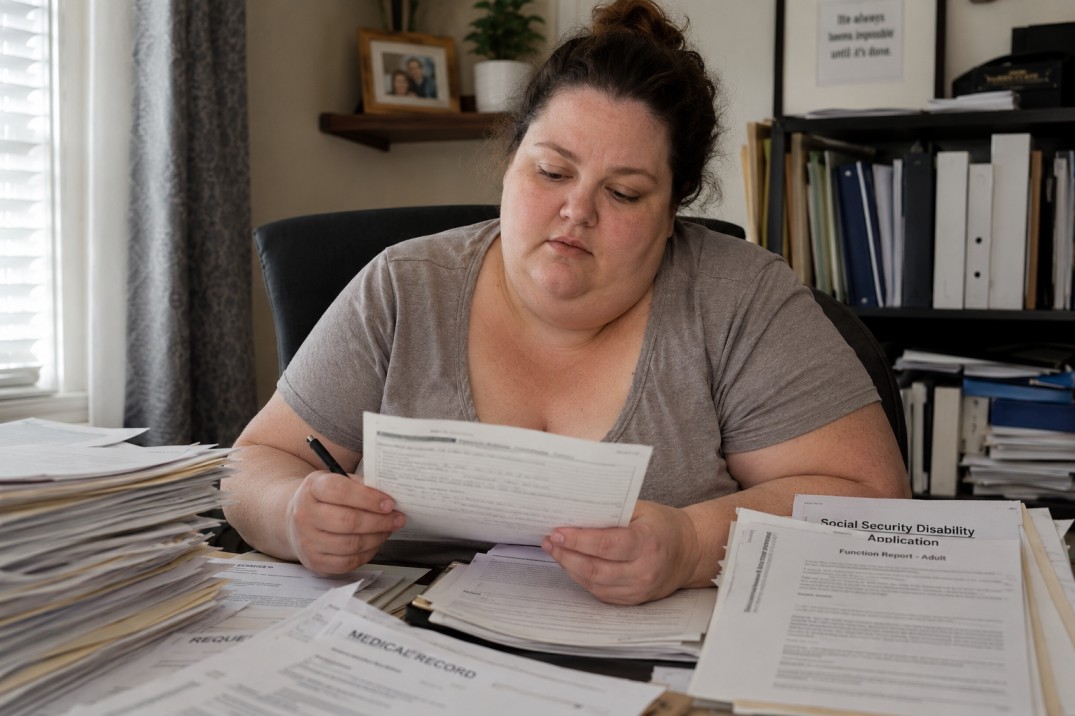

This article draws from SSA Blue Book Listing of Impairments, Part A, Section 12.00 (Mental Disorders, Adults), SSA Publication EN-05-10153, and 20 CFR Part 404 Subpart P Appendix 1. Procedural standards referenced from 20 CFR §§404.1520, 404.1520a, and 404.1545. Figures verified as of May 2026.
SSDI for Mental Health Conditions – What Actually Qualifies in 2026
Derrick Holloway had worked as a logistics coordinator for eleven years before his major depressive disorder made it impossible to maintain a consistent schedule, manage deadlines, or function reliably in a team environment. He had two hospitalizations in eighteen months, a failed medication trial, and a psychiatrist who had been treating him for four years. He applied for SSDI. SSA denied him at the initial level. They denied him again at reconsideration. His denial letters cited “insufficient medical evidence.”
His psychiatrist had submitted records. His therapist had submitted records. Derrick couldn’t understand what was missing.
What was missing was not the diagnosis — it was the functional documentation. SSA does not award SSDI based on a mental health diagnosis. It awards SSDI based on demonstrated functional limitations severe enough to prevent any sustained full-time work. The distinction sounds bureaucratic. In practice, it is the reason the majority of mental health SSDI claims are denied at the initial level — not because the conditions aren’t real, but because the records don’t speak SSA’s language.
This article explains exactly what SSA requires, which mental health conditions qualify and under what standard, and what makes the difference between approval and the cycle of denials Derrick experienced. Our broader Blue Book qualifying conditions guide covers the full listing structure across all impairment categories.
Why Mental Health SSDI Claims Are Denied at Higher Rates Than Physical Claims
The GAO and SSA’s own administrative data consistently show that mental disorder claims have lower initial approval rates than musculoskeletal or cardiovascular claims. A 2022 SSA analysis of disability determination data found initial approval rates for mental disorders hovering around 20–25% — lower than the overall initial approval rate of approximately 21% across all conditions, though the gap between mental and physical conditions widens significantly at the reconsideration stage.
This is a GuideForBenefits.com analysis synthesized from SSA OIG reports and Blue Book Section 12.00 documentation: The structural reason for this gap is the nature of psychiatric evidence itself. A herniated disc shows on an MRI. Severe depression does not produce an equivalent objective imaging finding. SSA examiners evaluating mental health claims rely almost entirely on treatment records, clinician statements, and functional assessments — and those documents vary enormously in how well they capture functional limitation versus symptom description.
A psychiatrist who writes “patient presents with depressed mood, poor concentration, and low energy” has described symptoms. A psychiatrist who writes “patient is unable to maintain attention and concentration for more than 20 minutes, cannot reliably complete a full workday without decompensating, and missed 9 of 14 scheduled appointments in the past two months due to avolition” has described functional limitations. SSA needs the second kind of record. Most treatment notes produce the first.
How SSA Evaluates Mental Health Claims — The Two Pathways
Under 20 CFR §404.1520a, SSA uses a specialized technique for evaluating mental impairments that applies on top of the standard five-step sequential evaluation. There are two ways to be approved for SSDI based on a mental health condition:
Pathway 1: Meet a Blue Book Listing (Section 12.00)
If your condition and its documented severity precisely match a listing in Blue Book Section 12.00, SSA will find you disabled at Step 3 without evaluating your residual functional capacity. This is the faster path — but the standards are demanding.
Pathway 2: Medical-Vocational Allowance (RFC)
If your condition doesn’t meet a listing, SSA assesses your Residual Functional Capacity (RFC) — what you can still do despite your limitations — and then determines whether any jobs exist in the national economy that you could perform given your age, education, and work history. Most SSDI approvals for mental health conditions come through this path, under 20 CFR §404.1545(c).
The RFC path is where documentation strategy matters most, and where the gap between what your treatment providers write and what SSA needs is widest.
The Blue Book Mental Health Listings — What Each Requires
SSA’s Blue Book Section 12.00 covers the following mental disorder categories for adults. Each requires both a clinical diagnosis and documented functional severity:
| Blue Book Listing | Condition Category | Key Severity Requirement |
|---|---|---|
| 12.02 | Neurocognitive disorders | Extreme limitation in 1 area OR marked limitation in 2 areas of mental functioning |
| 12.03 | Schizophrenia spectrum & other psychotic disorders | Extreme in 1 OR marked in 2 areas |
| 12.04 | Depressive, bipolar, and related disorders | Extreme in 1 OR marked in 2 areas |
| 12.06 | Anxiety and obsessive-compulsive disorders | Extreme in 1 OR marked in 2 areas |
| 12.07 | Somatic symptom and related disorders | Extreme in 1 OR marked in 2 areas |
| 12.08 | Personality and impulse-control disorders | Extreme in 1 OR marked in 2 areas |
| 12.10 | Autism spectrum disorder | Extreme in 1 OR marked in 2 areas |
| 12.11 | Neurodevelopmental disorders | Extreme in 1 OR marked in 2 areas |
| 12.13 | Eating disorders | Extreme in 1 OR marked in 2 areas |
| 12.15 | Trauma- and stressor-related disorders (PTSD) | Extreme in 1 OR marked in 2 areas |
The four “areas of mental functioning” SSA evaluates under each listing are:
- Understanding, remembering, or applying information
- Interacting with others
- Concentrating, persisting, or maintaining pace
- Adapting or managing oneself
“Marked” limitation means functioning is seriously limited. “Extreme” means unable to function independently, appropriately, or effectively. These are defined terms under Blue Book Section 12.00E — not clinical descriptors, and not the same as what a psychiatrist might mean when they use similar language in a treatment note.
There is a third pathway to meet some listings: demonstrating a “serious and persistent” mental disorder with a documented history of at least two years of treatment AND evidence of marginal adjustment — meaning the person has minimal capacity to adapt to changes in environment. This pathway, under 12.00G, is important for people whose conditions are well-controlled by ongoing treatment but who would decompensate without it.
The Four Functional Areas — What SSA Is Actually Measuring
This is where most applicants’ records fall short. SSA examiners score each of the four functional areas on a five-point scale: no limitation, mild, moderate, marked, or extreme. The score is derived from the medical evidence — and if the medical evidence doesn’t address these areas directly, examiners fill in the gaps with their own assessment, often at the “moderate” level.
Understanding, remembering, or applying information: Can you follow multi-step instructions? Learn new tasks? Remember appointments, medications, and commitments reliably?
Interacting with others: Can you respond appropriately to supervisors, coworkers, and the public without significant difficulty? Manage conflict without decompensating? Maintain composure under standard workplace stress?
Concentrating, persisting, or maintaining pace: Can you complete tasks on time, with consistent pace, at an acceptable error rate? How often do you need breaks beyond standard allowances? How long can you sustain attention before the quality of your work degrades?
Adapting or managing oneself: Can you manage personal care, respond to routine changes, handle ordinary workplace stressors without significant deterioration?
A person with severe depression might have marked limitations in concentration and adapting — but their treatment records may say only “mood improved on current medication regimen.” That improvement notation, without functional context, will be read by an SSA examiner as evidence of adequate functioning.
What Most People Get Wrong About Mental Health SSDI Claims
The most common misconception: that a severe psychiatric diagnosis, combined with a treating physician’s letter saying “my patient cannot work,” is sufficient for approval.
It is not sufficient, and here is why.
SSA does not give treating physician opinions automatic controlling weight under the current rules. Under 20 CFR §404.1520c, which replaced the old treating source rule in March 2017, SSA evaluates all medical opinions for “supportability” and “consistency” — meaning the opinion must be well-supported by objective medical evidence and consistent with the overall record. A one-paragraph letter saying “this patient is unable to work due to depression” fails the supportability test if the treatment notes it’s based on show only symptom descriptions without functional ratings.
What SSA actually needs is a structured medical source statement — sometimes called a mental RFC questionnaire — in which the treating clinician specifically rates the patient’s ability to function in each of SSA’s domains. Many psychiatrists and therapists don’t provide these unless explicitly asked. Many don’t know SSA’s specific framework. This is not a failure of care — it is a documentation gap that applicants and their representatives need to actively close.
Concrete Examples: What Approval and Denial Look Like
Example 1 — Approved (PTSD, RFC pathway): Maria, 44, a former emergency room nurse with combat-adjacent PTSD following a workplace shooting. Her records included two years of weekly EMDR therapy notes documenting hypervigilance, inability to tolerate loud environments, three panic attacks per week average, and a functional assessment from her psychologist rating her as markedly limited in interacting with others and adapting. Her vocational history showed skills tied to high-stress, team-based clinical environments. SSA determined her RFC precluded even sedentary work with standard workplace contact. Approved at the reconsideration stage after 8 months.
Example 2 — Denied (Depression, insufficient functional documentation): Thomas, 38, diagnosed with major depressive disorder, two hospitalizations in the prior year, on his fourth medication combination. His psychiatrist submitted progress notes from 18 months of visits. Every note documented mood, affect, and medication adjustments. None rated functional capacity. SSA denied at initial level and reconsideration, citing “evidence does not establish marked or extreme limitation in areas of mental functioning.” Thomas appealed to ALJ — his attorney obtained a structured RFC questionnaire from his psychiatrist rating him as markedly limited in three functional areas. Approved at the ALJ hearing level, 22 months after initial application.
Example 3 — Approved (Bipolar I, Blue Book listing met): Renee, 51, with Bipolar I disorder and documented rapid cycling episodes. Her records showed four psychiatric hospitalizations in 18 months, each triggered by manic episodes requiring inpatient stabilization. Between episodes, her outpatient notes documented ongoing impairment in adapting and managing herself. SSA found she met Listing 12.04 based on documented extreme limitation in adapting or managing oneself during cycling episodes. Approved at initial level in 4 months.
The difference between Thomas’s 22-month path and Renee’s 4-month path was not the severity of their conditions — it was what the records showed in SSA’s specific framework.
The RFC Pathway — How It Works When You Don’t Meet a Listing
Most mental health SSDI approvals happen here. If SSA finds you don’t meet a Blue Book listing, they assess your mental RFC — the most you can still do in a work setting despite your limitations. Under 20 CFR §404.1545(c), mental RFC covers your ability to understand and carry out instructions, respond to supervision and coworkers, and deal with work pressure.
SSA then runs this RFC through a vocational analysis. If your RFC limits you to “simple, routine tasks with minimal social interaction and low-stress environments” — a common mental RFC formulation — SSA asks whether jobs fitting that profile exist in significant numbers in the national economy.
This is where age becomes strategically important. For applicants 50 and older, SSA’s Medical-Vocational Guidelines (the “Grid Rules,” 20 CFR Part 404 Subpart P Appendix 2) create pathways to approval based on limited education and work history that don’t apply to younger applicants. A 52-year-old with a mental RFC limiting them to unskilled work, whose prior work was all skilled, may be approved under a Grid rule even without meeting a listing. A 34-year-old with the identical RFC faces a harder vocational analysis because SSA assumes greater ability to adapt to different work types.
[TOOL OPPORTUNITY: A mental RFC outcome estimator — allowing users to input their functional limitation ratings and age to see likely vocational outcomes — would be a high-value interactive tool for this article.]
The Chronic vs. Episodic Problem — An Institutional Failure in How SSA Evaluates Mental Health
SSA’s evaluation framework was built primarily around the concept of consistent, stable limitation. A herniated disc limits you at a predictable level every day. Mental health conditions frequently don’t work that way.
Bipolar disorder produces episodes of incapacitation separated by periods of relative functioning. PTSD may be well-managed for months, then triggered into acute crisis. Borderline personality disorder may produce intermittent but severe decompensation that doesn’t show up in routine outpatient notes.
SSA’s rules technically acknowledge this variability — Blue Book Section 12.00D(3) addresses “waxing and waning” symptoms and states that an applicant’s functioning during periods of relative stability is not the sole measure of their limitation. But in practice, SSA examiners often focus on the most recent clinical notes, and if those notes reflect a period of relative stability, the examiner may rate functional areas as mild or moderate.
This means a person with a genuinely disabling episodic condition may look like a “moderate” case during the administrative review if their records don’t clearly document the frequency, severity, and duration of their decompensating episodes — not just their stable periods. Getting those episodes documented, in specific functional terms, is one of the most important things a mental health SSDI applicant can do before filing.
What to Do Before You File — Documentation Strategy
Based on SSA’s framework under 20 CFR §404.1520a and Blue Book Section 12.00:
| Action | Why It Matters |
|---|---|
| Ask your treating clinician to complete a mental RFC questionnaire | Provides structured functional ratings in SSA’s framework |
| Request that progress notes document specific functional limitations, not just symptoms | Examiners cannot infer marked limitation from symptom descriptions alone |
| Document missed work, hospitalizations, and ER visits with dates | Establishes severity and episode frequency |
| Track and document daily functioning in writing | A personal function report (SSA Form SSA-787) should reflect your worst functioning, not your best day |
| Maintain consistent treatment | Gaps in treatment are used by SSA to imply improvement or non-severity |
| Do not delay filing | The SSDI onset date can be backdated to when disability began, and back pay accrues from the established onset date — under 20 CFR §404.621 |
The last point matters financially. If Derrick’s onset date is established as 18 months before his application date, his back pay could represent a significant lump sum. Our SSDI back pay calculation guide covers how that calculation works.
What Happened to Derrick
Derrick hired a disability attorney after his second denial. The attorney obtained a structured mental RFC questionnaire from his psychiatrist — a four-page document rating Derrick’s ability to function in each of SSA’s domains, with supporting references to specific treatment notes. The questionnaire documented marked limitation in concentrating and maintaining pace, and marked limitation in adapting and managing himself.
At his ALJ hearing, 19 months after his initial application, he was approved. His back pay — calculated from his established onset date — totaled $22,400 after the attorney’s fee.
The records that existed when Derrick first applied were not inadequate because his condition wasn’t severe enough. They were inadequate because no one had asked his psychiatrist to document his functioning in the specific terms SSA requires. That gap cost him 19 months.
If you’ve already been denied, the process from here is different — our SSDI appeal guide explains the four stages, what changes at each level, and why ALJ hearings have significantly higher approval rates than initial determinations. And if you’re comparing approval rates across states, our SSDI approval rates by state analysis shows how dramatically outcomes vary by geography even for identical conditions.
Frequently Asked Questions
Can SSA require me to attend an independent psychiatric examination?
Yes. Under 20 CFR §404.1517, SSA may purchase a consultative examination (CE) from an independent examiner if the existing evidence is insufficient to make a determination. For mental health claims, this is a psychiatric or psychological CE. The CE is paid for by SSA, and you are generally required to attend. CE reports often underestimate severity — the examiner sees you once, often during a period of relative stability, and has no long-term treatment relationship. Counter this by ensuring your treating clinician's functional ratings are in the record before the CE, not after.
My condition isn't in the Blue Book — can I still qualify?
Yes. SSA is required to evaluate conditions that don't precisely match a listing using the RFC process described above. Additionally, SSA can find that a combination of impairments — even none of which individually meets a listing — collectively produce a listing-equivalent level of severity under 20 CFR §404.1526. A person with moderate depression, moderate anxiety, and chronic pain may qualify through the combination of all three even if no single condition meets a standalone listing.
How does SSA treat mental health conditions that developed from a physical disability?
SSA evaluates the combined effect of all medically determinable impairments — physical and mental. A person who developed severe depression secondary to chronic pain qualifies to have both the pain and the depression evaluated together under 20 CFR §404.1523. The mental RFC assessment will include limitations from both sources. This is particularly relevant for veterans with service-connected physical and psychiatric conditions, where the interaction between impairments may collectively produce greater limitation than either alone.
Now that you know what SSA looks for in mental health claims, the next most important thing to understand is what happens after a denial. Most mental health SSDI claims are denied at least once — here’s how to fight back: SSDI Denied – How to Appeal
This article provides general educational information only and does not constitute legal, financial, or medical advice. Individual benefit outcomes depend on specific facts, documentation, and circumstances. Consult a licensed disability attorney or accredited benefits counselor for advice specific to your situation. GuideForBenefits.com is not affiliated with the Social Security Administration, Department of Veterans Affairs, or any US government agency.